Monday, 5 January 2015

Berlin Germany with the Zipfs

In mid November we visited Berlin Germany with Stef Zipf (one of Megan's bridesmaids), James Denue, Stef's parents and her brother.  Stef's mother grew up in Germany and her father was stationed in Berlin for a few years during the Cold War, so it was a great opportunity to learn from former locals.  They showed us around to some of the key historical attractions and they taught us about German culture.

Enjoying a beer with the Zipf family!
Us at the Brandenburg Gate

Historical Berlin

It's hard to think of a city more intertwined with the history of the 20th century then Berlin.  It was the capital of Germany during both World Wars.  Following the defeat of the Nazis in WW2, Berlin was divided into sectors and West Berlin would be an outpost of democracy surrounded by communist East Germany.  Berlin was the site of a major blockade/airlift, an infamous wall, many espionage adventures, and the fall of communism.  Walking around Berlin you can see many of the building and landmarks that played a pivotal role in world history.  There are bullet holes from the Battle of Berlin in 1945.  There are still standing sections of the Berlin Wall with varying levels of artistic and political graffiti. There is the iconic Brandenburg gate - site of so much history including the fall of the Berlin Wall.  There is the Kaiser Wilhelm Memorial Church - a bombed out building that was left in disrepair as a testament to the destruction of war.  The list goes on and on
The Kaiser Wilhelm Memorial Church - left bombed out as it was at the end of WW2
The Berlin Cathedral with a shot of the TV tower to the left and the Altes museum in the foreground.
In addition to the landmarks there are also great museums to see in Berlin.  We visited the DDR museum which shows what life was like under communist rule.  Life under communism started off with optimism and then steadily grew into poverty and despair.  The museum had many interactive components including a driving simulator in a Trabant car, a model communist home, a voting simulation (spoiler: if you don't vote for the communist party it doesn't end well) and a modified foosball game showing the futility of playing for East Germany.  We later found out that the East German secret police (the largest police force ever) would break into people's homes and 1) steal their underwear and 2) move their possessions around to create paranoia and make their victim's questions their sanity.
The infamous Trabant cat - made of plastic, frequently broken and with a waiting list of 14 years!
Modified Foosball at the DDR museum - The East German side
can only defend against the West German side, with no way to score!
Another great museum we visited was the German Historical Museum.  The exhibits were very robust and well constructed.  It was fascinating seeing how Germans portray their role in history.  Besides the museums we took a History Walking Tour.  There we passed by many of the aforementioned monuments and learned more of Germany's history.  It was insightful, moving and thought provoking.  We even learned that the costumed guards at Checkpoint Charlie are actually strippers.
Checkpoint Charlie = tourist trap

New Berlin

While Berlin has a fascinating past, it also has an exciting future.  It's blessed with heaps of amazing art including the aforementioned graffiti.  The Holocaust Memorial is a moving example of great artwork in the physical space.  Berlin also has a thriving technology startup scene.  It's changing industries with new fascinating companies.  The blend of art and technology has created a culture that attract the hip and cool of Europe.
The Holocaust Memorial at Dusk
Another shot of the Holocaust Memorial at dusk.
During our visit the Christmas markets started opening up.  They are a German tradition and although they've inevitably taken a modern slant in terms of goods and availability and location, they still hold some German traditions such as the wood decor and food offered.  It seemed like there were markets everywhere in Berlin and it was only mid November!
Christmas Market at Night
Beer Advent Calendar!  24 days of beer.
Fried Pork Knuckle is fantastic
Berlin has a thriving nightlife scene.  It has both really cool bars and pumping nightclubs.  If you want to party from 3pm on Wednesday night thru 4am on Monday you can do that in Berlin.  Megan and I passed on the club scene though and explored the pub/bar scene.  We sampled quite a few places and they all struck me with their: friendliness - it was easy to interact with locals, beer quality - they had an awesome selection of beers including some from Saugatuck Michigan, music - the music was typically good and always at a perfect volume (not too loud to talk but not too quite that it's awkward) and entertainment - in the form of foosball or shuffleboard or trivia or something else unique and interesting.  Berlin's beer scene was awesome.  Beerlin/Barlin.

German food: pretzels, soups, and sausages with local beer at a German Beer Hall!
The beautiful Brandenburg Gates at night.

Friday, 2 January 2015

Barcelona with the ND Ultimate Crew

Barcelona is a city of culture and passion.  So who better to explore it with than our undergraduate Notre Dame ultimate frisbee friends on study aboard.  Heather, Pat, Jonathan and Ian provided great companionship, perspective and entertainment.  We took this trip in mid-October.
Airport Shenanigans 

Walking the walk

We arrived mid-morning Friday and quickly caught up with Pat and Heather.  Jonathan and Ian would end up joining us later as they bozo booked flights for 8pm instead 8am.  Our Friday goals were quite modest with the intent to drink sangria, eat tapas, and explore Barcelona.
One of the many beautiful streets in Barcelona
We started off to visit the Bari Gothic museum near the medieval quarter.  While wandering we stumbled upon a museum which we thought was it.  It was not it.  Instead of learning about the Roman origins of Barcelona and seeing the ancient ruins, we visited what could be described as a museum of hoarding.  A rich gentlemen decided to collect many things: pipes, seashells, crucifixes, maps, weapons, printing presses, etc. which then were showcased as a museum posthumously.  An example of the curiosities is this bizarre naked child on an ugly fish sculpture.
Did not make my Christmas list

Park Guell

Saturday with the whole squad assembled we visited Park Guell.  It's one of the highest points in Barcelona and provides amazing views of the city and ocean.  The park was designed by the famous Barcelonian architect Antoni Gaudi.  It's a cool blend of nature and architectural design.
Great view of Barcelona
On top of the Guell.
The psychedelic part of the park designed by Gaudi

La Sagrada Familia

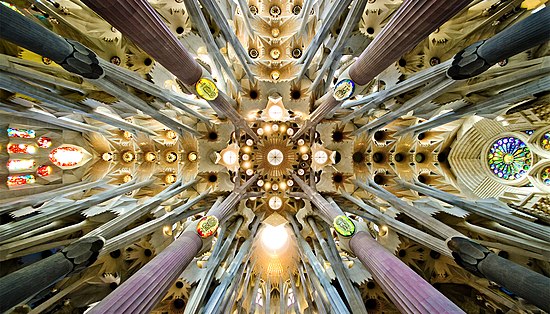
No visit to Barcelona is complete without visiting La Sagrada Familia.  La Sagrada Familia was designed by Gaudi and has been under construction for over 133 years.  It's an awe inspiring blend of art, architecture and engineering.  It towers over the neighboring construction and yet is elegant with it's impressively detailed sculptures and stained glass.  The project is just over 50% finished and has a planned completion date of 2026 but many challenges still exist.  It was amazing to see and is inspiring as a truly unique piece of art.  I recommend the wikipedia page to learn more.
The Nativity Facade
The Nativity Facade
The Glory Facade

Interior details of the columns that support the roof.

The Beach

After a day of sightseeing on Saturday we hit the beach near the center of the city.  The weather was sunny and delightfully warm.  The beach was packed and as we walked to a more empty spot we realized public nudity was accepted.  While none of our crew decided to engage in suitless bathing, we did test out the chilly Mediterranean waters.
Look closely and you may see a naked old man.

Delicious Food

While in Barcelona we had plenty of delicious food.  Being on the coast, Barcelona is heavy into seafood and the seafood paella was delicious.  It had a great blend of fresh seafood, Spanish spices, fresh veggies and rice.  The paella was a nice compliment to the cervezas and sangria.
We also had flavorful tapas (small appetizer dishes).  The most memorable was Can Paixano which served delicious cheap jamon sandwiches.  Heather, Pat, Megan and I shared four sandwiches and complimented them with tasty white wine.

The Nightlife

No trip to Bareclona would be complete without sampling the legendary nightlife.  Things in Barcelona start to get busy around midnight.  On Friday night we tried an 80's bar around 10pm only to find it empty and full of unpleasant bouncers.  At one point we got stared down by a bouncer, who was making sure we didn't have too much fun too early.
Selfie in the club.
Pat, Heather and Ian Doing their best to have fun
We left our first club of pessimism and journey in search of the epic Raz-Ma-Tazz.  Our journey was a bit Odyssey-esque in nature as we zig-and-zagged and ran into numerous hold-ups and distractions.  When we arrived we realized our Oz was less than we hoped for.  We found a line an hour long and a cover charge the size of small nation's GDP.  In a move we will never regret we headed back to the hostel to grab a kebab before the local shop closed.

Saturday night was wildly more successful.  We joined the Be-Sound Hostel pub crawl.  We frequented an Irish Bar (with some of the worst Karaoke), a Turkish hookah bar with exotic dancers, and a techno bar where they encouraged pants sagging.  During the pub crawl we made friends with two fellas from Texas A&M and a couple weird French dudes.  The last stop on the pub crawl was an Asian techno club that opened out onto the beach.  The crew soon tired of the club scene and spent the majority of the night drinking beers and relaxing on the beach until the wee hours of the morning.  Some of the group got separated but eventually by early morning we all made it back to the hostel for at least a few hours of sleep before our flights back to the real world beckoned.
Exhausted at the airport
My major takeaway was that Barcelona is a cool place full of life, art, and the interesting!  I highly recommend a visit.

Sunday, 16 November 2014

Saturday, 15 November 2014

A lovely weekend trip to Oxford

Fancy dinner we weren't invited to.  Hogwarts anyone?
Oxford is one of the oldest universities in continuous operation and also one of the prettiest and most unique.  Quick cool fact about Oxford University.  It's older than the Aztecs.
Beautiful building and quad - they are very protective about their quads.

One weekend in September we visited our friend Holden who does his fair share of travel and just completed his MBA at the amazing Said Business School.   He was a gracious host and showed us around the beautiful campus of Oxford, took us to some of the unique pubs and encouraged us to see the beautiful English country side.
One of the oldest public houses in Oxford, complete with low ceiling and crooked floors.
Turf Tavern - where Bill Clinton famously "did not inhale"

Another beautiful school
We also went punting!
Jeff steering the ship (it's hard) while Holden chills

Action shot of Holden

Megan glamour shot

What a day!

Wednesday, 12 November 2014

Venice: Book Smarts and Canal Smarts

We write from aboard a train in Northern Italy; taking us from Venice to Florence.  The lush green fields with pastel houses are an interesting contrast to the canals and concrete urban-ness of Venice.


We loved Venice.  It’s a controversial tourist destination in that visitors either love or hate it.  We were in the former category based on: our ability to get off the beaten path, our interest in history, and our trip’s timing (late October – good weather with smaller crowds).

Venice’s population of 55 thousand is small relative to the millions of tourists that visit annually.  Consequently the economy is geared to serve tourists.  Common sites included tourists restaurants, stalls hawking souvenirs, gondola drivers offering rides and tourists meandering around with cameras.  There are heaps of tourists traps but there are also just as many great exciting places to try.  We took a great tour on our first full day and were rewarded with dense history, architectural trivia and insider dining tips.  A little bit of research and one can handle the hordes and skip the traps with ease.


San Marco Square - home of the tower and Saint Mark's Basilica

Venice as an idea is really cool.  It’s a city built in a lagoon on mud hills.  It came to prominence during the middle ages when barbarian invasions forced Italians to take safety in the seas.  Venice grew in prominence from the 9th to the 15th century.  Venice’s growth was fueled by trade with the East and managed expertly through political and military maneuvering.  Venice’s wealth was concentrated amongst the noble families.  The noble families returned the money to the city through churches, artwork, and celebrations.   Venice today is full of gorgeous churches ornately decorated on the exterior and interiors and chuck full of beautiful artwork.  There are also many museums housing the overflow of great artwork made by Venetian artists or sponsored by wealthy Venetians. 
One of the countless beautiful churches in London
We knew Venice was famous for canals but what surprised us was that it has only canals and sidewalks.  There are no cars, Vespas or bikes allowed.   The majority of buildings are right on top of the canals so getting from one place to another can be tricky as one has to zig and zag through sidewalks and plan strategically to find the bridges.  The first day was quite difficult.  By the second day we learned to use sign posts for key landmarks to navigate through the labyrinth.  Our intrepidness was an asset as we explored the paths less taken and were open to new experiences right around the corner.  The canals make Venice a scenic romantic place with plenty of good photography options.
The mean streets of Venice
Venice provided an opportunity to indulge in Italian cuisine.  We had our fair share of Gelato pre and post dinners.  The first night we found a unique local wine dispensary which provided great wines at low prices.  We purchased bottles of Prosecco and enjoyed them in a piazza at dusk. 

We also sampled an Italian aperitif called Spritz.  It’s a mixture of bitter sweet alcohol with club soda.  It goes down very easily and cleanses the palate to increase one’s appetite.  The Spritz helped clear the way for the pizza.  We found a local place, Ae Oche, that provided great thin crust pizza with a tasty tomato and mozzarella based sauce.  The most interesting type we had was Venetian which had mussels (in the shell), clams, prawns, octopus, crawfish, and calamari.  Somehow it all worked together to provide a tasty seafood experience. 

Lastly I will leave you with a great Mitch Hedberg joke: "In Venice, Italy they don't have streets, they have canals. So in Venice, we gotta keep the kids off the canals. In Venice if you're not book smart, but you do know what's going on, you are canal smart. "I got canal smarts [man]!"


Monday, 10 November 2014

Budapest: Ruin Bars, Baths, and ... (Belated Post)

Ruin Bars, Baths, and ….

The last stop on our Central Europe adventure before school (back in August) was Budapest, the capital of Hungary.  Hungary has an incredibly interesting history that differs from most of Europe.  The original Hungarians were a nomadic group from Mongolia and were later taken over by the Turkish empire.  This explains why Hungary has a culture and language that is strikingly different than much of Europe. Because we were at the end of our trip we were looking forward to more relaxing activities: dining and Turkish baths. 
Enjoying a beer at an outdoor cafe in central Budapest    
Like in Poland and Czech Republic, we started off our trip doing a free walking tour of the city.  This helped us to get our bearings and learn some of the history of Hungary and Budapest.  Our walking tour highlighted some of the beautiful architectural buildings in Budapest namely St. Peters and Mathias’ churches.  The architecture, rolling hills, and the Danube make Budapest a beautiful city.  We were able to take it all in by doing a river cruise at night and hiking to the top of Gellert hill to take in the sweeping views.   This was one city where it’s worth it to take the hop-on-hop-off tour given the diversity and spread of so many sights. 
Parliament Building at Night.
Hop on, Hop off, Tourist shot!
Budapest used to be two cities separated by the Danube: Buda and Pest.  The Pest side is made up of rolling hills and includes the Palace and St. Mathia’s Church.  It is generally considered to be the wealthier side of Budapest.  The Buda side, which houses St. Peter’s Church is a little grittier but houses the trendy up and coming Jewish Quarter district.  The Jewish Quarter is famous for its “Ruin Bars”, which are old dilapidated buildings or courtyards that have been turned into trendy bars and clubs.  We tried out a few and our favorites were Szimpla Kert (third best bar in the world) and Instant.  These are a must see if you go to Budapest.  This area also plays host to some of Budapest’s best restaurants.  Thanks to some recommendations from our friends we were able to eat very well in Budapest!
Szimpla Bar - it's massive, this ins only a tiny area.
One of the best ways to enjoy the Turkish influence in Budapest is to visit a Turkish Bath.  Budapest sits on over mineral hot springs, which supply numerous world famous Turkish bathhouses in the city.  Each bathhouse is a little bit different and can range from opulent indoor bath spas to open air night spa clubs.  Since it was really hot in August we set our sights on Palatinus, which is all outdoor and on San Margaret island on the Danube.  What we ended up getting was a Hungarian water park, complete with a wave pool, waterslides, and hot pools with floating chess boards.  It wasn’t exactly what we were expecting, but since it was off the beaten path we were the only tourists there we got some quality people-watching.   We also sampled the Hungarian equivalent of carnival food which is langos.  Langos are a fried doughy base with cheese and toppings on top.  Like a doughnout pizza.  As you can guess they scored high on taste and low on health.

Our trip included a dive into Hungarian history.  We visited the Hungarian history museum which boasted an extensive collection of artifacts and well written exhibits.  Hungary has been through some incredibly high times (near the end of the 19th century) and through some incredibly lows ones as well: World War II and Communism.   
Liberty Statue - one of the few remaining communist monuments
We also took a communism walking tour to learn about life under communism and the political activity in Budapest.  Our tour had a special guide who was passionate about politics.  He spent the majority of time explaining the worrying trends in Hungarian politics.  Whereas the majority of Eastern Europe is moving towards more open markets and democracy, Hungary is become more isolated and despotic.  It’s a trend that is highlighted by the Holocaust monument debacle – where the current party created an insensitive and inaccurate portrayal to spin Hungary’s involvement in WWII.  
Buda Castle
 Our total time in Budapest was about four days.  We certainly saw and experienced much of what this fascinating city has to offer.  The end of our Central Europe trip marked our transition from funemployment to full time students at London Business School.